84 films — 34 hours — from the exercise physiologists, sports scientists and clinicians who study how the body adapts to training, in their own words and at length. Every video id was checked against YouTube before it shipped and every runtime was fetched rather than estimated. Nothing loads from Google until you press play — the thumbnails are served from this site, and the player only appears when you ask for it.
Essentials
Start here.
 Play2 h 01 mAndrew HubermanDr. Andy Galpin: How to Assess & Improve All Aspects of Your Fitness | Huberman Lab Guest SeriesA systematic pass through the measurable qualities of fitness — strength, power, endurance, speed, flexibility, body composition — and the tests used to assess each.Why it’s worth itThe best single map of the territory. It treats fitness as a set of separable, measurable qualities rather than one number, which is the framing the rest of this library depends on.
 Play34 minAndrew HubermanEssentials: How to Build Strength, Muscle Size & Endurance | Dr. Andy GalpinHow strength, muscle size and endurance are distinct adaptations, driven by different stimuli and supported by different physiology.Why it’s worth itThe condensed version of the distinction that most training confusion comes from — that the three adaptations are not the same thing arriving in different amounts.
 Play2 h 12 mPeter Attia MD217 ‒ Exercise, VO2 max, and longevity | Mike Joyner, M.D.A physician-researcher on cardiorespiratory fitness, what VO₂ max measures, and the cohort evidence relating it to mortality.Why it’s worth itThe bridge between the training literature and the longevity literature, from a Mayo physiologist who has worked on both. It is the film the cardiovascular research category is built around.
 PlayAndy GalpinThe Fundamentals of Training for Muscle, Strength & LongevityGalpin walks through the physiological building blocks any training plan rests on, covering muscle size, strength, endurance and fuel systems, and how each adapts differently to a stimulus.Why it’s worth itThe clearest single-sitting map of the whole territory from a working muscle physiologist, and it frames everything else in the library.
 PlayEdith Cowan UniversityExercise is Medicine: Prof Rob Newton, The West Australian - ECU Lecture SeriesNewton reviews the clinical trial evidence behind exercise as a therapeutic agent, drawing on his group's work in cancer, ageing and chronic disease.Why it’s worth itA university lecture from one of the most cited researchers in exercise oncology, pitched at a general audience rather than a specialist one.
 PlayBarbell MedicineSarcopenia Lecture w/ Dr. Austin BarakiBaraki examines what sarcopenia actually is, how it is defined and measured in the literature, and what the resistance training and protein research show about age-related muscle loss.Why it’s worth itA practising physician reading the primary literature carefully, and a rare lecture-length treatment of ageing muscle rather than a soundbite.
 PlayNSCAResistance Training for the Aging Adult: An Evidence-Based Approach, with Brent Alvar | NSCA.comAlvar surveys the evidence base on resistance training in older adults, including the meta-analytic work on dose, adaptation and functional outcomes across the lifespan.Why it’s worth itAn NSCA conference lecture from a researcher who co-authored the field's foundational dose-response meta-analyses.
 PlayIron Culture PodcastEp 372 - New ACSM Lifting GuidelinesHelms and Eric Trexler read through the revised ACSM resistance training position stand, discussing where the committee's conclusions track the recent literature and where they lag behind it.Why it’s worth itIt shows how expert consensus documents are actually built and argued over, which is more instructive than the conclusions themselves.
 PlayRenaissance PeriodizationDifferences in Training for Strength vs SizeIsraetel separates the adaptations behind maximal force production from those behind muscle growth, examining where the two overlap and where they pull in different directions.Why it’s worth itThe most watched serious treatment of a distinction that most training talk collapses, from a sport physiology PhD.
 PlayStephen SeilerTowards a shared mental model of the endurance training processSeiler lays out a conceptual model of the endurance training process, connecting intensity distribution, workload accounting and adaptation into one framework coaches and scientists can share.Why it’s worth itSeiler is the researcher who defined polarised training, and this is his attempt to give the field a common language.
 PlayDr. Layne Norton PodcastKeys To Building Muscle Part 1: TRAINING | Episode 17Norton works through the training side of muscle gain, examining what the intervention literature supports on effort, progression and exercise variation, and where it stays uncertain.Why it’s worth itA nutritional sciences PhD who publishes in the area, arguing from the studies rather than from gym convention.
The library
Everything, by subject.
 PlayExercise physiology55 min#18 - Integrative physiology of exercise with Dr Michael JoynerInside ExerciseAn integrative account of exercise physiology — how the systems that respond to a training stimulus act together rather than separately.Why it’s worth itSets up the whole discipline before any single mechanism is examined, which makes the more specialised interviews in this category readable.
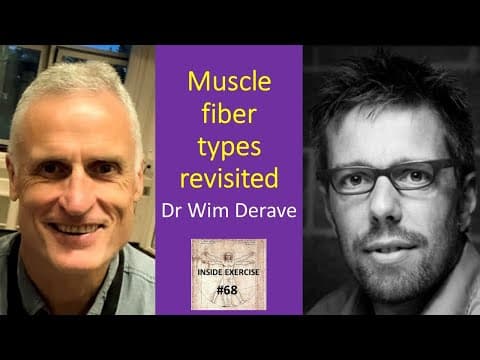 PlayExercise physiology2 h 01 m#68 - Muscle fiber types revisited with Professor Wim DeraveInside ExerciseWhat is currently understood about muscle fibre types, and why the textbook classification has been substantially revised.Why it’s worth itA case study in a settled idea turning out to be less settled than the diagrams suggest — useful for calibrating how much any tidy classification should be trusted.
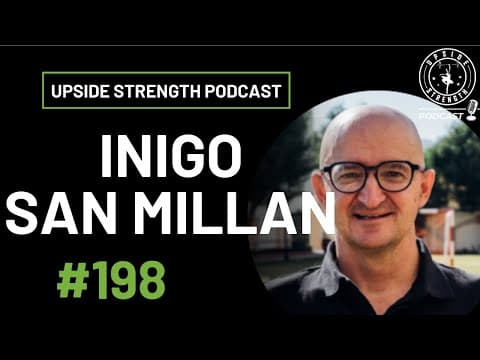 PlayExercise physiology1 h 14 mInigo San Millan on Mitochondria, Lactate & Zone 2 || Episode #198Upside StrengthMitochondrial function, lactate as a metabolic signal rather than a waste product, and the physiology behind low-intensity aerobic training.Why it’s worth itExplains where the zone 2 conversation actually comes from, at the level of substrate handling, from the physiologist most associated with it.
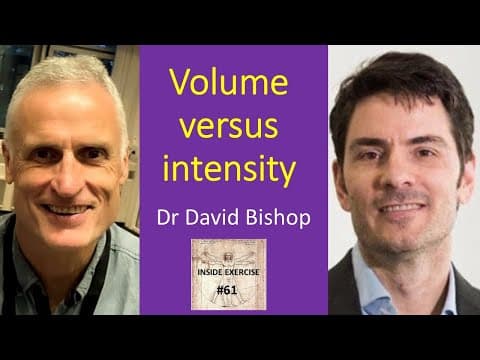 PlayExercise physiology1 h 21 m#61 - Volume versus intensity with Dr David BishopInside ExerciseThe long-running research question of what training volume contributes independently of intensity, and how the studies separating them are designed.Why it’s worth itThe dose-response question examined as a methodological problem rather than a settled prescription — it pairs directly with the meta-regressions in the research library.
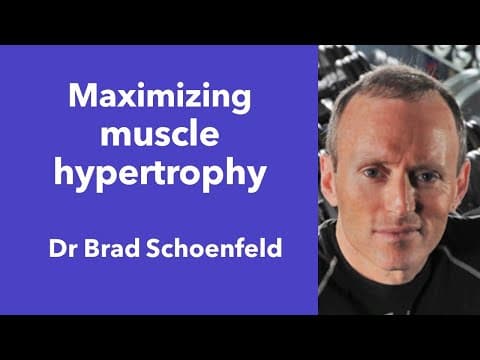 PlayStrength & hypertrophy1 h 18 m#51 - Maximizing muscle hypertrophy with Dr Brad SchoenfeldInside ExerciseThe hypertrophy literature from the researcher behind much of it — what the trials measured, and where the evidence is stronger and weaker than commonly stated.Why it’s worth itThe single most cited name in the hypertrophy dose-response work, on his own findings and their limits.
 PlayStrength & hypertrophy26 minManipulating muscle protein turnover to maximize exercise adaptations, Stuart PhillipsThe Physiological SocietyA Physiological Society lecture on muscle protein turnover and how it responds to exercise and to feeding.Why it’s worth itMechanism at lecture depth rather than interview depth, from the laboratory that generated much of the protein dose-response data the nutrition course cites.
 PlayStrength & hypertrophy1 h 52 m#73. Protein and muscle adaptations to loading and unloading with Professor Luc van LoonInside ExerciseHow muscle protein synthesis responds to loading, and what happens on the other side of the equation when a limb is unloaded or immobilised.Why it’s worth itThe unloading half is rarely covered and is where the strongest effects are. It reframes training as protecting against loss as much as producing gain.
 PlayRecovery55 minWhy We Sleep: Science of Sleep & Dreams | Matthew Walker | Talks at GoogleTalks at GoogleA neuroscientist on the biology of sleep and dreaming, and what sleep does across memory, metabolism and physical function.Why it’s worth itThe foundation film for the recovery category — recovery physiology is unreadable without the sleep biology underneath it.
 PlayRecovery1 h 25 m#70 - Sleep, recovery and fatigue in athletes with Professor Shona HalsonInside ExerciseSleep, recovery and fatigue in athletic populations, and the difficulty of measuring recovery in a way that means anything.Why it’s worth itDirectly on the measurement problem: recovery is widely discussed and poorly quantified, and this examines why.
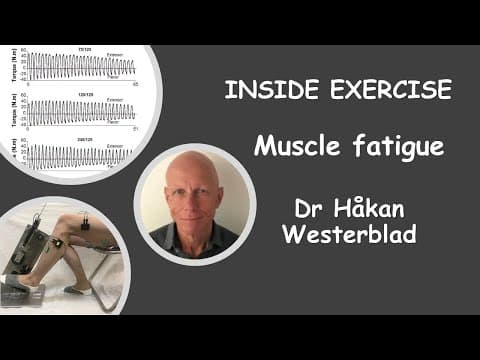 PlayRecovery1 h 35 m#23 - Muscle fatigue with Dr Håkan WesterbladInside ExerciseWhat fatigue is at the level of the muscle fibre — the ionic and metabolic events that reduce force production.Why it’s worth itFatigue described as a physiological state with mechanisms rather than a feeling. It is the mechanistic floor under the whole recovery category.
 PlayRecovery1 h 18 mCafé Scientifique: Overtraining and the Everyday AthleteSFU Faculty of ScienceA public lecture on overtraining — how the syndrome is defined, how it is distinguished from ordinary hard training, and why diagnosis is difficult.Why it’s worth itOvertraining is invoked constantly and defined rarely. This covers the diagnostic criteria the consensus statements actually use.
 PlayCardiovascular2 h 43 mDr. Martin Gibala: The Science of Vigorous Exercise — From VO2 Max to Time Efficiency of HIITFoundMyFitnessThe physiology of high-intensity work — what happens to VO₂ max and cardiometabolic markers, from the researcher behind much of the interval-training literature.Why it’s worth itThe interval-training evidence from the laboratory that generated a large share of it, including where the effects are smaller than the popular account.
 PlayCardiovascular1 h 28 m#41 - Zone 2 training: why all the talk? With Dr Andrew CogganInside ExerciseWhat zone 2 training means physiologically, where the terminology came from, and what the underlying evidence does and does not support.Why it’s worth itA sceptical treatment of a term that has escaped its definition, from a physiologist central to developing the power-based training models it rests on.
 PlayCardiovascular1 h 01 mUnderstanding VO2 Max: Why Exercise Matters for Heart Health and LongevityStanford Health CareA hospital lecture on VO₂ max — what the measurement represents, how it is taken, and how it relates to cardiovascular health.Why it’s worth itThe clinical framing rather than the athletic one, which is the register most of the mortality evidence was generated in.
 PlayMobility & injury2 h 52 mBuild a Strong, Pain-Proof Back | Dr. Stuart McGillAndrew HubermanSpine mechanics and back pain from a biomechanist who spent a career studying loading in the laboratory.Why it’s worth itBack pain is the most common movement complaint and the most poorly served by general advice. This is the biomechanics underneath it, from primary research rather than convention.
 PlayMobility & injury1 h 20 mTendinopathy rehab 101 | Physiotutors Podcast Ep. 020 | Jill CookPhysiotutorsTendinopathy — how tendons respond to load, why they fail, and what the rehabilitation literature reports.Why it’s worth itFrom the researcher whose work defines the modern tendinopathy model. Tendon adapts on a different timescale from muscle, which is the single most useful thing to know here.
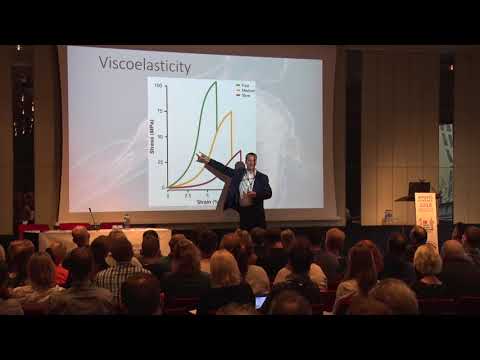 PlayMobility & injury50 minKeith Baar - Physical training, performance and injury preventionSportskongresHow connective tissue adapts to mechanical loading, and what that implies for the study of injury prevention.Why it’s worth itConnects the molecular biology of collagen and tendon to the applied injury-prevention literature — the mechanism under the trials.
 PlayMobility & injury1 h 35 mWeekly Lesson - TENDON ADAPTATION TO MECHANICAL LOADING IN SPORTS, HEALTH AND DISEASE - AnniversaryECSS .tvA sports-science lecture on tendon adaptation to mechanical loading, across sport, health and ageing.Why it’s worth itThe formal academic treatment of the same tissue, presented to a research audience rather than a general one.
 PlayMeasurement1 h 28 mHeart Rate Variability - New perspectives and insights with Marco Altini, PhD | EP#325Scientific TriathlonHeart-rate variability — what the measurement captures, how noisy it is, and how it is used to monitor training response.Why it’s worth itThe most misread number in consumer fitness tracking. This covers what it can support and where the interpretation breaks down.
 PlayMeasurement38 minDr. Iñigo San Millán: What Lactate Testing & VO2 Max Reveal About Longevity | The Metabolic FilesHuman Powered HealthWhat laboratory lactate and VO₂ max testing measure, and what those measurements indicate about metabolic health.Why it’s worth itThe laboratory counterpart to the wearable conversation — what a real physiological assessment involves, from a physiologist who runs them.
 PlayMeasurement1 h 11 mHow Physiological Testing Picks Your Best Workouts | VO₂max, Lactate, LT1/LT2, Zones & IntervalsFast Talk LaboratoriesHow physiological testing data is interpreted, and what a full assessment does and does not tell an athlete.Why it’s worth itTesting treated as something with interpretive limits rather than a verdict, which is the correct posture toward every number in this category.
 PlayExercise physiologyHit Training - Mechanisms of Adaptation - Prof. GibalaECSS .tvGibala presents the molecular and cardiovascular mechanisms behind adaptation to high intensity interval work, drawing on his laboratory's comparisons with longer continuous exercise.Why it’s worth itA congress lecture from the researcher whose McMaster group generated much of the primary data on interval physiology.
 PlayExercise physiologyPhysiological adaptations to interval exercise training: New insights Martin GibalaThe Physiological SocietyGibala reviews newer findings on how interval exercise reshapes skeletal muscle and cardiovascular function, including which adaptations appear to be intensity dependent.Why it’s worth itA physiology society lecture aimed at scientists, with the mechanistic depth that popular coverage of intervals leaves out.
 PlayExercise physiologyPhysiological limits to exercise performance: Influence of gender, Michael JoynerThe Physiological SocietyJoyner analyses the physiological ceilings on human performance and how they differ between men and women, working through the cardiovascular and muscular determinants.Why it’s worth itJoyner is the Mayo Clinic physiologist who models human performance limits, and sex differences are the sharpest test of those models.
 PlayExercise physiologyConcurrent Exercise Training (MPLS 2016): Dr. Kevin MurachMuscle Physiology LabMurach reviews the molecular basis of the interference effect, examining what happens when endurance and resistance stimuli are combined in the same muscle.Why it’s worth itA research seminar on the question every hybrid athlete faces, answered at the level of signalling rather than anecdote.
 PlayExercise physiologyExtending an Active Life: Insights from Molecular Exercise Physiologist with Professor Keith BaarUC Davis Health Office of Wellness EducationBaar discusses how connective tissue, muscle and metabolic health respond to loading across a lifetime, drawing on his laboratory's collagen and tendon research.Why it’s worth itBaar is the molecular exercise physiologist behind much of the current tendon loading science, speaking here about the long game.
 PlayExercise physiologyHeat Acclimation by Dr Michael SawkaAspetar سبيتارSawka presents the physiology of heat acclimation, covering plasma volume expansion, sweating responses and the time course over which they develop and decay.Why it’s worth itSawka led US Army environmental physiology research for decades, and heat adaptation is among the most reliable effects in the literature.
 PlayExercise physiologyThe Power-Duration Relationship: Mechanisms of Vascular Control - Prof. PooleECSS .tvPoole examines the power-duration relationship and the vascular control mechanisms that set the boundary between sustainable and unsustainable exercise intensities.Why it’s worth itPoole co-developed the critical power construct, and this is the mechanism behind a model that increasingly drives endurance testing.
 PlayStrength & hypertrophyCritical Muscle Growth Training Variables: Ranked & ExplainedData Driven StrengthPelland and Robinson rank the training variables studied in the hypertrophy literature by how much evidence supports each one mattering, from range of motion to exercise selection.Why it’s worth itThe pair behind the recent dose-response meta-regressions applying their own evidence standards to the entire variable list.
 PlayStrength & hypertrophyVolume and Strength: New Science Explained | S2E10Data Driven StrengthA long-form walk through their meta-analysis on training volume and strength, covering how volume was quantified, which studies qualified and what the dose-response curve looked like.Why it’s worth itA rare episode in which researchers narrate their own analysis decisions, which is where meta-analyses live or die.
 PlayStrength & hypertrophyEverything You Need To Know About Training Volume & Hypertrophy - Greg NuckolsRevive StrongerNuckols works through what the volume literature can and cannot support, discussing measurement problems, individual variation and how effect sizes have shifted as studies improved.Why it’s worth itNuckols reads more of this literature than almost anyone, and here he is unusually explicit about the limits of what is known.
 PlayStrength & hypertrophyHow to Grow Muscle (ft. Dr. Brad Schoenfeld)Stronger By ScienceSchoenfeld outlines the mechanisms proposed to drive muscle growth and reviews how mechanical tension, metabolic stress and muscle damage have fared under testing.Why it’s worth itSchoenfeld authored a large share of the hypertrophy trials, and this is a compact statement of where he now thinks the evidence sits.
 PlayStrength & hypertrophyWhat makes muscle grow?Menno HenselmansHenselmans examines the proposed drivers of hypertrophy and argues which of them survive scrutiny once the weaker studies are set aside.Why it’s worth itA sharply argued mechanistic overview from a researcher who publishes on training methodology and is willing to break with consensus.
 PlayStrength & hypertrophyThese 2 fundamentals build the most muscle & strengthMenno HenselmansHenselmans identifies the two variables he argues carry most of the explanatory weight in the training literature, and why the rest matter far less than they are discussed.Why it’s worth itA useful corrective to variable-obsessed training culture, argued from meta-analytic data rather than preference.
 PlayStrength & hypertrophyBret Contreras | Muscle Building, Glute Training & the Latest ResearchEscape FitnessContreras discusses his electromyography and hypertrophy research, how the hip thrust literature developed, and what more recent studies have changed about his views.Why it’s worth itContreras built an entire research line from scratch, and he is candid here about where his early conclusions did not hold.
 PlayStrength & hypertrophyEp. 72- Principles of Progression for HypertrophyIron Culture PodcastHelms examines the principle of progression as it appears in the hypertrophy literature, including how overload has been operationalised in studies and where the models conflict.Why it’s worth itHelms is a published researcher and coach, and progression is the variable most training discussion assumes rather than examines.
 PlayStrength & hypertrophyA SECRET Way to Grow Muscle? (Science Explained)Dr. Milo WolfWolf reviews the evidence on training muscles at long lengths and what the stretch-mediated hypertrophy studies do and do not demonstrate.Why it’s worth itWolf completed his doctorate on this exact question, and it is currently the most contested topic in the hypertrophy literature.
 PlayStrength & hypertrophy181: Brad Schoenfeld - An updated view on the mechanisms of muscle hypertrophyRevive StrongerSchoenfeld revisits the mechanisms of hypertrophy in an extended interview, explaining why his position on muscle damage and metabolic stress has changed.Why it’s worth itWatching a leading researcher publicly revise his own model is worth more than any settled summary.
 PlayRecoveryAvoid Fitness Plateaus, Overtraining & Mis-Timed Performance Peaks | Perform with Dr. Andy GalpinAndy GalpinGalpin examines plateaus, the evidence around overtraining and overreaching, and how peaking and fatigue have been studied in athletes.Why it’s worth itGalpin has worked with elite and professional athletes for years, and this separates measurable fatigue states from the folklore around them.
 PlayRecoverySleep Is the Ultimate Performance Hack | Dr. Cheri Mah on Recovery, Longevity & Human OptimizationPlayersTVMah discusses her sleep extension research with professional athletes and what the data show about sleep duration, reaction time and injury risk.Why it’s worth itMah ran the Stanford studies that put sleep on the elite sport agenda, and she is describing her own findings.
 PlayRecoveryOvertraining Syndrome: Causes, Diagnosis, and What's Actually Going OnBarbell MedicineTwo physicians examine what overtraining syndrome means across coaching, clinical and wearable contexts, and why the systematic review evidence for it is so thin.Why it’s worth itA genuinely sceptical treatment of a term used constantly and defined almost never.
 PlayRecoveryRelative Energy Deficiency in Sport (RED-S) by Dr Margo MountjoyAspetar سبيتارMountjoy explains relative energy deficiency in sport, the physiological systems affected by low energy availability, and how the IOC consensus developed.Why it’s worth itMountjoy chaired the consensus group, so this is the origin account of a syndrome that now underpins much of athlete health screening.
 PlayRecoveryThe Science of Recovery with Dr. Shona Halson | Technogym PodcastTechnogymHalson reviews the recovery interventions that have been tested in athletes, which of them have supporting evidence, and how recovery is periodised around competition.Why it’s worth itHalson led recovery research at the Australian Institute of Sport, and she is direct about which popular methods lack support.
 PlayRecoveryIndividualized Diagnosis of Fatigue and Recovery Needs - Dr. HeckstedenECSS .tvHecksteden examines how fatigue and recovery status might be diagnosed at the individual level, and why group-average markers so often fail for a single athlete.Why it’s worth itA congress lecture on the measurement problem sitting underneath every recovery claim.
 PlayRecoveryTraining Principles Lecture 4- Fatigue Management with Dr. MikeRenaissance PeriodizationIsraetel distinguishes the several forms of fatigue that accumulate during training and how each has been described in the periodisation literature.Why it’s worth itA widely watched lecture that treats fatigue as several distinct phenomena rather than one undifferentiated feeling.
 PlayCardiovascularLong, low intensity endurance sessions: When is Low too low? When is Long too long?Stephen SeilerSeiler analyses the duration and intensity boundaries of low intensity endurance work, using training data from elite endurance athletes to ask when easy becomes too easy.Why it’s worth itSeiler's most watched lecture, and the clearest evidence-led answer to the question polarised training raises.
 PlayCardiovascularAaron Baggish, MD, Is Too Much Endurance Exercise Bad for your HeartUW Medicine Center for Sports CardiologyBaggish reviews what sports cardiology knows about the hearts of lifelong endurance athletes, including coronary calcium, atrial fibrillation and the limits of the current data.Why it’s worth itBaggish is among the leading sports cardiologists working with elite endurance populations, and he is careful about causation.
 PlayCardiovascularAthletes, Astronauts, and Aging: The Adaptive Range of Human PerformanceYale Cardiovascular Medicine Grand RoundsLevine compares how the cardiovascular system responds to training, to spaceflight and bed rest, and to ageing, arguing that deconditioning and ageing share mechanisms.Why it’s worth itA cardiology grand rounds from the researcher whose bed rest and training trials underpin most claims about reversing cardiac stiffening.
 PlayCardiovascularThe athletes heart - when is adaptation good and when is it dangerous? Mats BorjessonThe Physiological SocietyBorjesson examines the structural changes seen in the athlete's heart and where the line falls between healthy adaptation and pathology.Why it’s worth itA sports cardiologist addressing the screening question that arises whenever endurance athletes present with unusual imaging.
 PlayCardiovascularProfessor Andy Jones: What Makes Kipchoge So Good?MarathonMedicineJones presents the physiological profile of Eliud Kipchoge, covering the maximal oxygen uptake, lactate threshold and running economy measurements behind marathon performance.Why it’s worth itJones tested Kipchoge himself for the sub-two-hour project, so the numbers discussed came from his own laboratory.
 PlayCardiovascularThe Science Behind Faith Kipyegon’s Sub-4 Minute Mile Attempt | Exclusive Interview: Dr. Andy JonesMarathon HandbookJones discusses the physiology and the aerodynamic and pacing modelling behind an attempt on a sub-four-minute mile by a woman.Why it’s worth itIt shows applied physiology used predictively rather than descriptively, explained by the scientist who did the modelling.
 PlayCardiovascularExercise Intensity Domains: Importance for Exercise Prescription in Clinical... - Dr. MezzaniECSS .tvMezzani sets out the exercise intensity domains defined by ventilatory and lactate thresholds, and how they are used to prescribe exercise in clinical populations.Why it’s worth itThe conceptual foundation beneath every training zone scheme, presented at source rather than through a popular translation.
 PlayCardiovascularMetabolic Determinants of the Critical Power - Dr. VanhataloECSS .tvVanhatalo examines the metabolic determinants of critical power, including muscle fibre recruitment and the phosphate responses seen with magnetic resonance spectroscopy.Why it’s worth itCritical power is becoming the standard model for endurance testing, and Vanhatalo helped establish its physiological basis.
 PlayMobility & injuryHow To Rehab Tendon Injuries & Pain (Exercises & Education for Tendinitis, Tendinosis, Tendinopathy)E3 RehabA physiotherapy overview of how tendon pain presents, what the imaging and pathology research shows, and how loading has been studied across the major tendinopathies.Why it’s worth itNearly a million views on the most evidence-anchored tendon explainer on the platform, made by practising clinicians.
 PlayMobility & injuryJill Cook - Current concepts in tendinopathy rehabilitationsportfisioswissCook presents her continuum model of tendon pathology and reviews what the rehabilitation literature supports at each stage.Why it’s worth itCook is the most cited tendinopathy researcher alive, and this conference talk is the source of the model everyone else cites.
 PlayMobility & injuryPatellar Tendinopathy with Ebonie Rio | EP. 085PhysiotutorsRio discusses patellar tendinopathy, the role of the nervous system in tendon pain, and what her isometric loading trials found.Why it’s worth itRio's work reframed tendon pain as a neuromuscular problem as much as a tissue one, and she explains the evidence herself.
 PlayMobility & injuryFive years of Hamstring Injury Research in 25 minutes | Dr David OparAspetar سبيتارOpar condenses five years of his group's hamstring injury research, covering muscle architecture, eccentric strength and what the risk factor data actually predict.Why it’s worth itHamstring injury is the most common injury in field sport, and Opar's laboratory produced much of the current evidence.
 PlayMobility & injuryDeadlifting Injury: Low Back and Leg Pain ft. Adam Meakins (Disc Herniation Discussion & Education)E3 RehabMeakins discusses his own disc herniation and return to lifting, alongside what the imaging and natural history literature says about back pain in lifters.Why it’s worth itA well known sceptic applying his own evidence standards to his own injury, which is unusually honest territory.
 PlayMobility & injuryCognitive Functional Therapy Masterclass Part One - Peter O'SullivanModern Pain PodcastO'Sullivan presents cognitive functional therapy, the biopsychosocial model behind it, and the trial evidence in persistent low back pain.Why it’s worth itO'Sullivan's RESTORE trial is among the strongest randomised evidence in low back pain, and this is his own masterclass on the approach.
 PlayMobility & injuryJeremy Lewis - Rotator Cuff Related Shoulder Pain & the athlete: Suggestions for managementsportfisioswissLewis examines rotator cuff related shoulder pain in athletes, questioning subacromial impingement as a diagnosis and reviewing what the management evidence supports.Why it’s worth itLewis led the reframing of shoulder pain diagnosis in physiotherapy, and this talk is aimed squarely at the athletic population.
 PlayMobility & injuryThe Truth About Stretching: What Does the Science Say?Steve MagnessMagness reviews the research on static and dynamic stretching, covering effects on performance, injury rates and range of motion.Why it’s worth itA clear-eyed reading of a literature far messier than either the pro-stretching or anti-stretching camps admit.
 PlayMobility & injuryTraining tendons; implications for sprinting, jumping and rehabilitation with Keith BaarSportsmithBaar explains tendon mechanics and collagen turnover, and how the loading research applies to sprinting, jumping and return from injury.Why it’s worth itBaar's engineered ligament work sits behind current tendon loading practice, presented here for practitioners.
 PlayMobility & injuryWhen is spinal pain less about the spine? Dr Kieran O’SullivanAspetar سبيتارO'Sullivan examines when spinal pain is driven by factors other than spinal tissue, including sleep, stress and beliefs, and what the evidence supports.Why it’s worth itA sports medicine lecture that treats the psychosocial evidence with the rigour usually reserved for tissue findings.
 PlayMeasurementWhat is Sport Science? | Essentials of Sport Science Live LectureDr. Jacob GoodinGoodin defines what sport science is as a discipline, how the practitioner role developed, and what separates measurement from decision making.Why it’s worth itA university lecture that gives the whole field of athlete monitoring its context before any device is discussed.
 PlayMeasurementThe Training Process: Quantifying Training Load | Essentials of Sport Science Live LectureDr. Jacob GoodinGoodin covers how training load is quantified, the internal and external load distinction, and the statistical problems with common workload metrics.Why it’s worth itThe clearest teaching treatment of load quantification, including honest coverage of where the acute-chronic ratio failed.
 PlayMeasurementMonitoring Wellness,Fatigue and Physical Performance...by Dr. Martin Buchheit-25March2013Aspetar سبيتارBuchheit reviews how wellness questionnaires, heart rate measures and physical testing are used to monitor athletes, and how noisy each of those signals is.Why it’s worth itBuchheit is one of the most published applied sport scientists in football, speaking from elite practice rather than theory.
 PlayMeasurementMonitoring Fatigue from A to Z, with Bryan MannNSCAMann surveys the methods used to detect fatigue in athletes, from jump testing and bar velocity to questionnaires, and what each can and cannot detect.Why it’s worth itAn NSCA lecture that runs the full range of monitoring tools and is frank about their signal-to-noise problems.
 PlayMeasurementVelocity Based Training - Dr Bryan MannGymAwareMann explains the load-velocity relationship, how velocity data is collected and interpreted, and the research behind autoregulating using bar speed.Why it’s worth itMann's doctoral work established much of the velocity-based literature, and this is the extended version of it.
 PlayMeasurementHow HRV insights can improve performance | Marco AltiniFloris GiermanAltini explains what heart rate variability measures physiologically, how measurement context distorts it, and how the data have been analysed in trained populations.Why it’s worth itAltini has published extensively on HRV measurement validity and is unusually clear about the ways the metric is misread.
 PlayMeasurementFitbit Air vs WHOOP | Scientific Test!The Quantified ScientistTer Horst tests consumer wearables against reference equipment for heart rate, sleep staging and oxygen saturation, and reports the agreement statistics.Why it’s worth itThe most rigorous independent wearable validation on the platform, run by a researcher who publishes his methods.
 PlayMeasurementTraining Smarter AND Harder with Dr Tim GabbettmetrifitGabbett discusses the relationship between training load and injury, the rationale behind load progression research, and where his own conclusions have been challenged.Why it’s worth itGabbett's work drove a decade of load monitoring practice, and he engages here with the criticism it has drawn.
 PlayMeasurementDr Paul Comfort (Keynote) - Optimising the Strength and Power ProgrammeCarnegie Adolescent Rugby ResearchComfort examines how strength and power qualities are assessed and tracked, covering isometric testing, jump metrics and the reliability of each measure.Why it’s worth itA keynote from a researcher who publishes the reliability studies that determine whether a testing number means anything.
 PlayMeasurementTalkin' Force Episode 08: Vertical Jump Testing & Jump Momentum with Dr. John McMahonHawkinMcMahon discusses countermovement jump testing on force plates, what the phase-by-phase metrics represent, and why jump momentum may outperform jump height.Why it’s worth itForce plate testing is spreading fast beyond elite sport, and McMahon is one of the researchers defining how the output should be read.
Titles, channels and runtimes verified 2026-08-04
These are third-party films hosted on YouTube; their contents are the speakers' views, not ours. This is educational reference material about the physiology of training, recovery and performance — not medical advice, not a training prescription, and not a claim about any product sold on this site. Several speakers discuss how they would programme training; describing what a researcher argues is not this site recommending it.